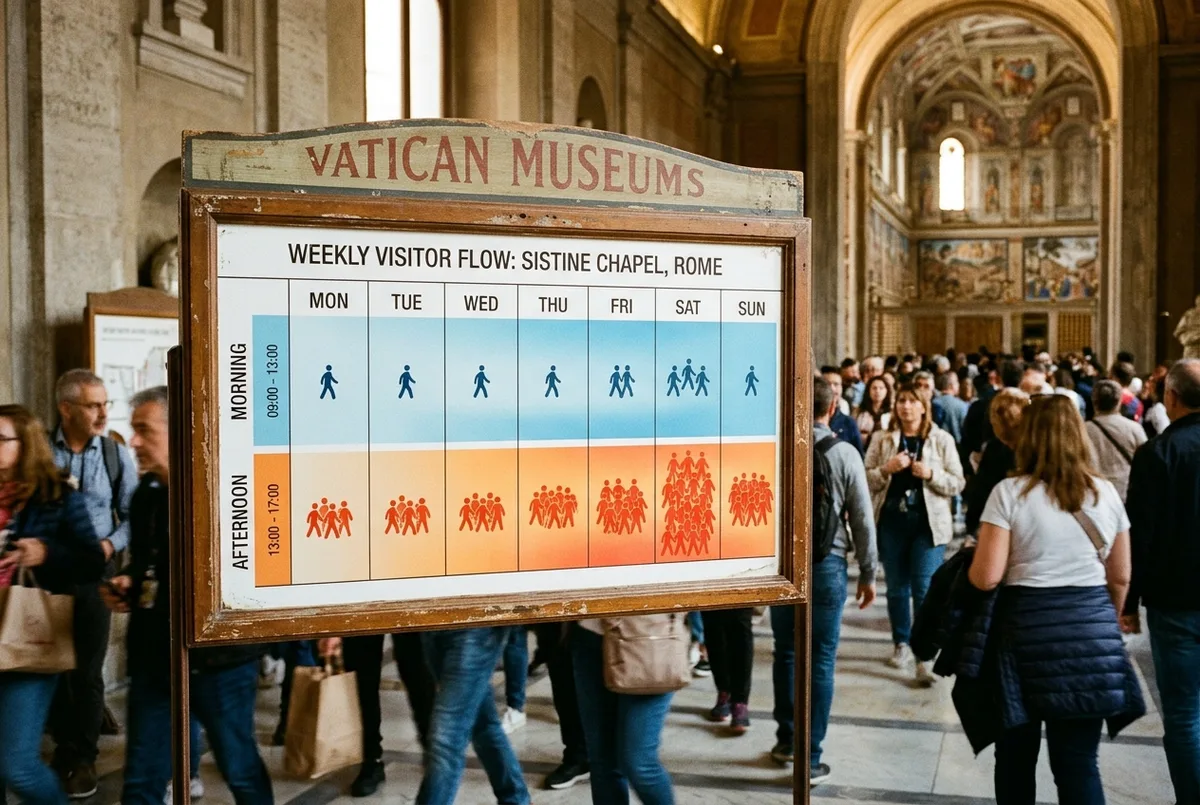
The best time to visit the Sistine Chapel is the first entry slot of the day, on a weekday, during the quieter shoulder season months. Here’s what I’d actually do if crowds are your main worry: book the earliest slot the Vatican Museums offer, pick a Tuesday through Thursday over a Monday or a weekend, and if your dates are flexible at all, lean toward November, January or February instead of the April through October rush.
I’ve looked at this from every angle readers ask about: time of day, day of week, and season, and they don’t carry equal weight. Time of day matters the most by far. A quiet Tuesday morning at 8am and a quiet Tuesday afternoon at 4pm are two genuinely different experiences once you’re actually standing under the ceiling, and I’d rank that choice above the other two every time.
What’s the quietest time of day to visit the Sistine Chapel?
The first entry slot, generally the first 60 to 90 minutes after opening, is consistently the calmest window of the day. The museum’s one-way route fills up steadily as the morning goes on, so the crowd that reaches the Sistine Chapel by 11am is the accumulation of everyone who entered since the doors opened, not just whoever is there right that minute. I’d take an 8am or earliest-available slot over anything else on this page without hesitation.
Last entry, usually in the late afternoon, sounds like a clever workaround, and it does dodge the pure midday peak. My honest take is that it’s still the second choice, not the first. By late afternoon, the Sistine Chapel has absorbed a full day’s worth of visitors who are all funneling toward the same exit, and the room can feel just as packed as midday even though new arrivals have slowed down.
Check prices & dates
Ready to visit?
Book your tickets in advance: popular time slots sell out.
Is a weekday or a weekend better for visiting the Sistine Chapel?
I’d pick a weekday, specifically Tuesday through Thursday, over any weekend without much debate. Weekends bring in local day trippers from elsewhere in Italy on top of the usual tourist traffic, and large school and tour groups tend to cluster their visits around Friday through Sunday. Monday is a reasonable middle option, though I’d note that several other major Rome museums close on Mondays, which nudges some of their visitors toward the Vatican instead.
One date I’d actively avoid if crowds matter to you: the last Sunday of the month, when admission is free. It’s a genuinely useful deal if your priority is saving money, but it is, without question, the single most crowded day the Vatican Museums see all month.
Does the season actually change how crowded the Sistine Chapel gets?
Yes, noticeably. Shoulder season, meaning November and the deep winter months of January and February, sees meaningfully thinner crowds than the April through October peak, when Rome’s tourist season runs at full strength. I’d plan a winter trip around this if seeing the ceiling without a packed room is genuinely important to you, since the gap between a January Tuesday morning and a July Saturday afternoon is enormous.
That said, two windows buck the seasonal pattern entirely: the week around Easter and the days surrounding Christmas and New Year. Both draw heavy crowds regardless of what the rest of the calendar suggests, so I wouldn’t assume a “quiet month” automatically means a quiet week if your trip lands on either of those dates.
Should I book an early entry tour or just arrive early with a standard ticket?
Both get you in the door early, but they aren’t the same experience, and I think this is where a lot of readers underthink the decision. A standard skip-the-line ticket booked for the first available slot still puts you in a group with everyone else who booked that same slot, which on a busy week can be a larger crowd than it sounds. An early entry tour, capped at a small group size, gets you into the galleries ahead of the general public entirely, which is a meaningfully different level of quiet.
I’d pay the premium for the early entry tour specifically if you’ve been in a packed version of the Sistine Chapel before and found it disappointing. If this is your first visit and you’re reasonably flexible about scheduling, a standard early-slot ticket still gets you most of the benefit for a fraction of the price. Our skip-the-line Vatican tickets guide breaks down exactly which queue each option actually skips, which is worth reading either way before you commit to one.
The group size difference matters more than people expect, too. A standard early ticket still funnels you in alongside everyone else who grabbed that same opening slot, which on a popular week can still be a sizeable crowd. An early entry tour caps its group well below that, so even “early” has a quieter version and a less quiet version, and I’d pay for the quieter one if the whole point of going early is to actually see the ceiling without craning around other people’s phones.
What about Wednesday mornings and the papal audience?
On Wednesdays when a papal audience is held, a large share of visitors heads toward St. Peter’s Square rather than the Vatican Museums that morning, which can mean a slightly thinner crowd inside the galleries themselves. I wouldn’t build a whole strategy around this, though, since audience schedules shift and aren’t guaranteed week to week. Check the current calendar before you count on it, and treat it as a nice possible bonus rather than a reliable plan.
Do cruise ship days change the crowd pattern?
Yes, and this is a factor a lot of guides skip over. Rome’s port, Civitavecchia, sends several thousand cruise passengers into the city on the days a large ship docks, and a meaningful share of them book a Vatican excursion for that same morning. I’d check the cruise schedule for your travel dates if you can, since a port day can noticeably thicken the crowd even on what would otherwise be a quiet shoulder-season Tuesday.
I wouldn’t let this override the rest of the advice on this page, since it’s one factor among several rather than the deciding one. But if you’re already choosing between two similar dates, I’d pick the one without a major ship in port, all else being equal.
How much time should I budget once I’m inside?
This depends heavily on whether you’re self-guided or on a guided tour, and how much of that time is actually spent in front of Michelangelo’s ceiling versus walking the galleries that lead to it. I’ve broken down realistic time budgets for every format sold on this site in our Vatican Museums tour duration guide, which I’d read before you lock in a start time, since arriving too close to a flight or dinner reservation is a common planning mistake.
What else should I check before I lock in a time slot?
A few practical details matter just as much as timing. The Vatican enforces the same dress code for every visitor regardless of when you arrive, and I’ve seen it catch out more travelers in hot weather than any other single rule; our Sistine Chapel dress code guide covers what to pack. If St. Peter’s Basilica is part of your plan the same day, its own opening hours and Mass schedule run on a separate clock from the Museums, which I’ve laid out in our St. Peter’s Basilica hours and Mass times guide. And if a Jubilee year lines up with your trip, our Holy Door and Jubilee Door guide explains what that actually changes about the Basilica visit.
For the fuller picture of how the Sistine Chapel, the Vatican Museums and St. Peter’s Basilica fit together as three separate things, I’d start with our visiting the Sistine Chapel guide, which this page builds on directly.
Ready to lock in an early slot? The Sistine Chapel early entry tour gets your small group in before the general public, which is the single biggest lever on this page for actually avoiding a crowd.
Frequently asked questions
What time do the Vatican Museums open?
Opening hours shift by season, so I’d always confirm the current schedule before you book, but the earliest slot of the day is consistently your best shot at a quiet Sistine Chapel regardless of the exact opening time that week.
Is the Sistine Chapel ever less crowded in the afternoon?
Occasionally, right at the very last entry slot before closing, but I wouldn’t count on it feeling noticeably calmer than midday. A full day’s visitors have usually funneled through by then, and the room can still feel busy.
Does bad weather reduce the crowds inside?
Sometimes, since outdoor sightseeing elsewhere in Rome gets less appealing in the rain, which can nudge a few more visitors toward indoor sites like the Vatican Museums rather than fewer. I wouldn’t plan around weather as a crowd-avoidance strategy.
Is the last Sunday of the month a good time to visit for free admission?
Only if saving money matters more to you than a calm visit. It is reliably the single most crowded day of the month at the Vatican Museums, so I’d skip it if avoiding crowds is your actual priority.
My bottom line: of the three variables on this page, time of day does the heaviest lifting, day of week comes second, and season is the long-term lever if your travel dates are genuinely flexible. Stack all three in your favor, an early weekday slot in a quieter month, and you’ll see a meaningfully different Sistine Chapel than the one most photos online make it look like.